Tag Archives: Instruction

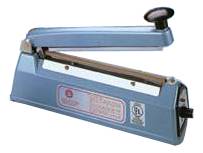
MAINTENANCE – for your Hand Impulse Sealer

Regular maintenance of your impulse sealer will ensure the longevity of your sealer.  After using between 1,000-5,000 seals, it is normal for the heating element (wire) to break .  The number is dependent on your timer setting and will vary from user to user.  Regularly replacing your sealer’s heating wire, PTFE adhesive (sticky brown protective skin under the element), and the PTFE cover (brown protective skin over the element) is essential for your sealer’s health and well-being.

An impulse sealer’s PTFE adhesive serves as a barrier between the heating element and the sealer’s body.  When the sealer’s heating element has burned through the bottom PTFE adhesive and arc’ed on the sealer’s body, the heating element will break and may also damage the timer.

**When replacing the heating element, you MUST also replace the bottom PTFE adhesive.  Make sure the PTFE adhesive is 1/4″ and 1/2″ past the machine on both ends.  This prevents the heating element from coming in contact with the sealer’s body.

Download our instructions on how to change your sealer’s heating wire and PTFE cover and adhesive here.

We carry replacement kits for all our sealers.   If you do not find what you are looking for, contact us!

Impulse Sealers – How to Achieve the Best Seal

Good seals require not only enough heat to melt a bag together, but also enough cooling time to allow the seal to set.  Our most common complaint is that a sealer is not creating a good seal and 99% of the time, the operator is not holding the arm down long enough to allow the seal to cool and set.   Manual impulse sealers such as your hand or foot sealer require a congeal or dwell step to create a proper seal on your bag or film.   To achieve the best seal, hold the arm or upper jaw of your sealer down for an additional 2-4 seconds after the signal light has turned off to allow the seal to cool and set.

Follow our simple instructions below and you will get great looking seals!
1)   Set the timer at 3 and place your bag on the seal surface.
2)  Bring the upper jaw and seal arm down on the bag and hold in place until the  timer light goes out and continue to hold the upper jaw or seal arm down for an additional 2-4 seconds to set or congeal the seal.
3)  Lift the upper jaw or seal arm; test the bag or film.  If the seal is strong, the timer setting is correct.  Increase or decrease the timer setting slightly and test again until you achieve the perfect seal.

**Higher timer settings and thicker materials require longer congeal times.
**Following the above instructions will lengthen the life of all the parts.

How to Choose a Heat Sealer

When selecting a sealer, it is important to have a sense of the material which will be sealed.  Try and have the material thickness and width available as this will make your selection process much easier.  This will ensure the sealer you purchase is capable of sealing your material.  If you want any sealer suggestions, fill out this easy questionnaire and we will provide you with some suggestions

This page discusses the four key characteristics of sealers to help you determine which best fits your application.
What is a heat sealer?
A heat sealer (ex: bag sealer, heat impulse sealer, direct heat sealer, hand sealers) is a machine used to seal plastic material using heat. There are many types of sealers and choosing the right sealer may be overwhelming without a few basic points.
Function

There are two main types of sealers: (1) impulse heat and (2) direct heat.

Impulse sealers require no warm up time and seal by applying a pulse of energy to the sealing area, followed immediately by cooling.  Impulse sealers only use power when the jaw is lowered.  We recommend an impulse sealer for any thermoplastic material such as polyethylene (PE) or polypropylene (PP) which requires a lower seal temperature.  Materials for impulse sealers:  Polyethylene, Polyurethane, Polyvinylchloride, Pilofilm, Polyvinyl Alcohol, Saran, Nylon, bubble packs, padded mailers, foil, coated bags, Kel-F, Polyflex, Mylar, Tyvek, and other thermoplastic material.  Impulse sealers are easy to use (no warm-up time), economical (electricity used only during sealing process), and safe (no component is always hot).

There are different types of impulse sealers based on type of material and usage:

  • Hand sealers can seal poly material up to 10mil thickness
  • Pedestal Type / Foot sealers can seal poly material up to 15mil in thickness
  • Auto sealers can seal poly material up to 15mil in thickness
  • Double impulse sealers (automatic and foot options) can seal poly material up to 20mil in thickness (We recommend double impulse for heavy duty applications)
  • Sealers w/cutters seal and trim excess material (tubing) in order to make customized bags

Direct heat (constant heat) sealers maintain constant heat in both jaws.  Direct heat sealers use power as long as the machine is turned on.  As a result, direct heat sealers possess better heat penetration in roder to seal thicker materials.  We recommend a direct heat sealer for materials such as coated aluminum foil, poly cello films, gusset bags, coated Kraft papers, waxed paper, cellophane, mylar, coated PP, and other thicker materials.

We also include other types of sealers used for more specific types of applications:

Vacuum sealers remove air from the product before sealing into an impermeable package.  We recommend vacuum sealing in order to prevent oxidation, spoilage or corrosion.  Barrier bags are used because PP and PE bags are both porous and cannot be used for long term storage.

Clam shell sealers are ideal for welding clam shell packaging.

Size

The size of the sealer depends on the width of the material to be sealed.  We usually recommend adding one inch to the width of material to be sealed for easier handling.  Cutters on the sealer usually trim at slightly less than width of the sealer arm.

Speed
  • Portable sealers are lightweight, handy and versatile.  Sizes, however, are limited.
  • Hand sealers are the most simple and economical unit.  The sealing bar is lowered manually.  Sizes are available from 4” to 40” and approximately 6-20 packages can be sealed per minute.
  • Foot sealers provide a faster seal than hand sealers.  The sealing bar is pedestal controlled leaving your hands free.  Sizes are available from 12” to 35” and approximately 8-20 packages can be sealed per minute.
  • Automatic sealers provide even faster sealing than foot sealers and are ideal for high production jobs.  Automatic sealers are usually tabletop sealers whose jaws are activated automatically by a dial-controlled sequence timer.  Automatic sealers feature a pre-set time cycle to allow for a fully continuous automatic operation.  Automatic sealers can also be used with a foot pedal for semi-automatic operation.  Sizes are available from 12” to 47” and approximately 20-50 packages can be sealed per minute.
  • Continuous band sealers provide the fastest sealing operation with an unlimited length.  Bags are simply fed into sealer while resting on a conveyor belt.  Several models are available with features such as horizontal seal head, vertical seal head, tilting seal head, left or right feed, gas purging, and/or coding and imprinting.
Width of Seal / Packaging Material

Heating elements are made of nichrome (nickel-chromium) and determine the width of the seal.  There are two types of heating elements: round or flat which are interchangeable in most sealers. The round wire is mainly used to cut and seal with no excess material above the seal.  Depending on the width of the flat wire element, sealers are available in 2-3mm, 5mm, 8mm, or 10 mm. Some sealers are equipped with two heating elements for faster heat penetration making them ideal for sealing thicker materials.


Standard Features of our Impulse Sealers

The all-metal construction of our sealers provides industrial quality strength and ensures lasting durability.  The body is formed out of rugged cast aluminum while the pivot is an all-steel construction.  Most sealers are equipped with a plug-in electronic timer and built-in microswitch.  No warm-up time is needed.  The variable timer let you seal various types and thickness of plastic films.  A signal light and “beep” indicates the heat cycle is complete and the seal is done.

The number in the model number usually indicates the size of the sealer in mm; so 200 points to an 8″ sealer while 1000 points to a 40″ sealer. The letter in the model number is used to designate the manufacturer and type of sealer.  For example, “H” signifies a hand sealer while an “A” suggests auto sealer.